

Visiting More Than One Schengen Country? Here’s Which Embassy You Must Apply To

If your trip covers more than one European country, say, a few days in France followed by a week in Spain, you can’t simply pick whichever embassy has the shortest waiting list or the nicest application centre. The Schengen Visa Code sets out a specific order of rules for deciding exactly one thing: which country’s embassy is responsible for your application. Get it wrong, and the correct embassy can legally return your documents, refund your fee, and redirect you, costing you the appointment slot you worked hard to secure.
This guide breaks down the “main destination rule” in plain English, with worked examples, so you apply to the right place the first time.
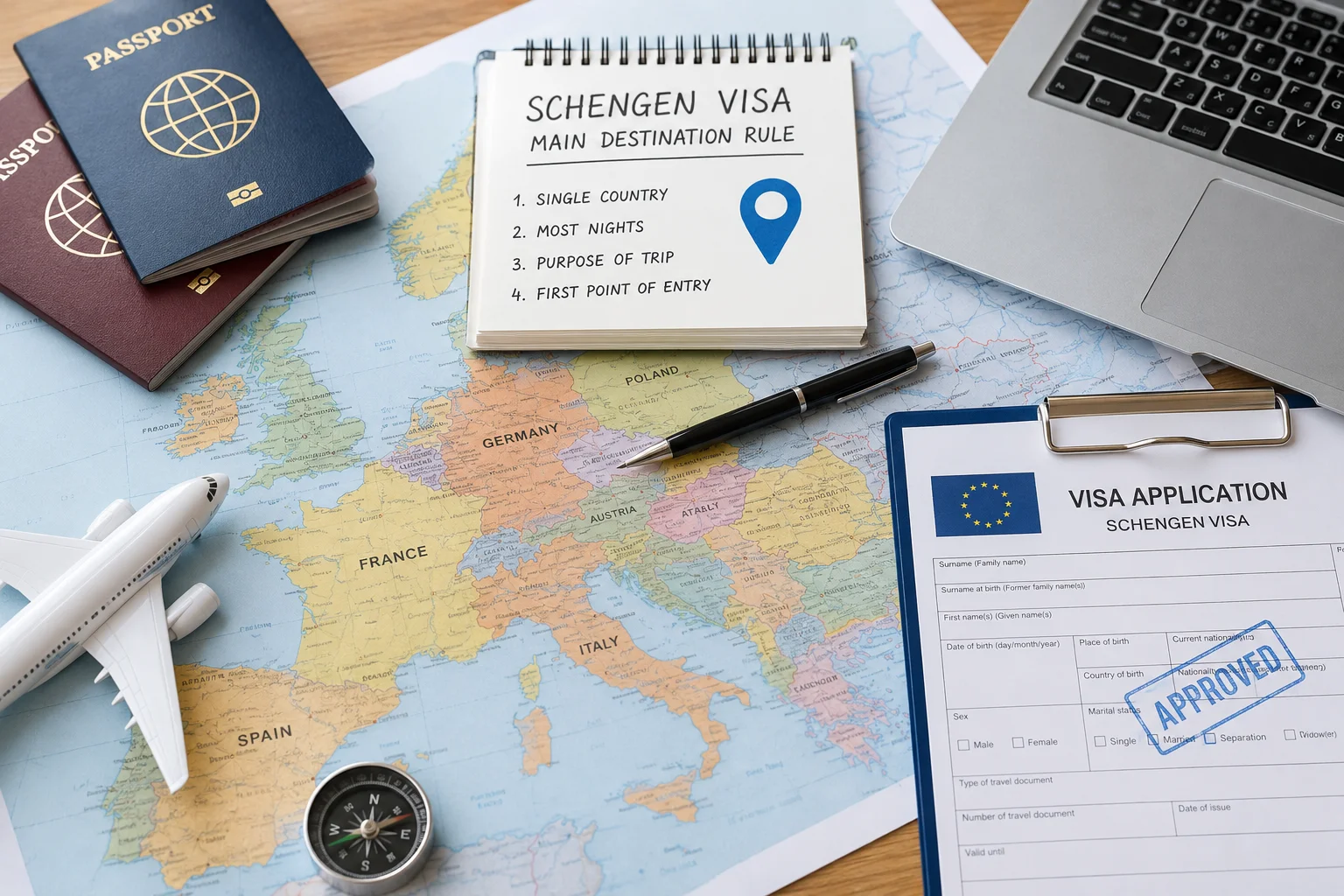
The Three-Step Rule, In Order
Officially, applicants only move to the next rule if the one before it doesn’t give a clear answer. Think of it as a ladder, you stop climbing as soon as one step answers the question.
Step 1: Are You Only Visiting One Country?
If your entire trip is contained within a single Schengen country, this is easy: you apply at the embassy, consulate, or visa application centre for that country, regardless of which airport your flight connects through.
Step 2: Where Will You Spend the Most Nights?
If you’re visiting multiple Schengen countries, the country where you’ll spend the greatest number of nights is your main destination, and that’s whose embassy handles your application, even if you land somewhere else first.
Example: You fly into Rome, stay one night, then travel on to spend six nights in France. Even though Italy is your first entry point, France is your main destination because it’s where you’re spending the most time. You’d apply to the French authorities, not the Italian ones.
Step 3: What’s the Primary Purpose of Your Trip?
Sometimes the “most nights” test gets overridden by purpose. If a specific reason for travelling, a conference, a wedding, a course, competing in a sporting event, is the actual reason for the trip, that country can count as your main destination even if you’ll spend more nights elsewhere on holiday afterwards.
Example: You’re attending a 3-day work conference in Germany, then taking a 7-day holiday in Spain afterwards. Spain has more nights, but if the conference is genuinely the purpose of the trip, Germany may be treated as the main destination, this is the area where applicants most often get it wrong, because the “purpose” test isn’t always as clean as it sounds on paper, and where nights and purpose conflict, it’s worth checking directly with the embassy in question.
Step 4 (Tie-Breaker): First Point of Entry
Only if you genuinely cannot identify a main destination, for instance, an equal number of nights in each country with no standout purpose, do you fall back to whichever Schengen country you’ll enter first.
Example: Four nights in Germany and four nights in Austria, flying into Frankfurt first. With no clear main destination, Germany becomes the responsible country simply because it’s your first point of entry.
Worked Examples At a Glance
| Trip | Main Destination | Why |
| 5 nights France, 3 nights Italy | France | Most nights |
| 1 night Italy (arrival only), 6 nights France | France | Most nights, despite first entry being Italy |
| 3-day conference Germany, 7-day holiday Spain | Depends on purpose vs. nights check with the embassy | Purpose can override night count |
| 4 nights Germany, 4 nights Austria, enter via Frankfurt | Germany | Equal nights → first entry tie-breaker |
Why This Rule Exists, And Why Embassies Enforce It Strictly
This isn’t a bureaucratic technicality. Under the EU’s Visa Code, a consulate is required to check it has jurisdiction before it processes your application at all. If it doesn’t, it’s obligated to hand back your documents and fee and point you to the correct country, not simply process it anyway as a courtesy.
Embassies have also become more attentive to itineraries that look “reverse-engineered” to fit a preferred embassy rather than reflecting a genuine travel plan. A route that enters a country for a single night before immediately reversing direction, or a return flight that doesn’t logically follow the stated itinerary, tends to invite additional questions, even if the paperwork is otherwise in order. The safest approach is to build your itinerary around where you’re actually going, then apply based on where that itinerary points.
Common Mistakes to Avoid
- Applying based on appointment availability, not your itinerary. A shorter queue at one country’s application centre isn’t a valid reason to apply there, consulates check jurisdiction before processing.
- Assuming your first flight destination is automatically your main destination. It’s only the deciding factor when nights are equal or no clear main destination exists.
- Building a “convenient” itinerary around a preferred embassy. Routes that don’t follow a logical geographic or purpose-driven flow can raise questions during review.
- Overlooking the purpose test. A short but purpose-driven visit (a conference, an event, a course) can sometimes outweigh a longer leisure stay elsewhere in the same trip.
- Not rechecking the rule for connecting flights. A connection through a Schengen airport, without leaving the international transit area, generally doesn’t count as a “visit” to that country for this rule, but always confirm your specific routing with the relevant embassy.

Frequently Asked Questions
Can I apply to whichever country’s application centre has the earliest available slot?
No. The embassy responsible for your application is determined by your itinerary, not appointment availability. Applying to the wrong consulate can result in your documents being returned and your fee refunded, without a decision being made.
What if I’m spending exactly equal time in every country on my trip?
Where the main destination genuinely can’t be determined by nights or purpose, the country you enter first becomes the responsible one for your application.
Does a visa issued by one Schengen country restrict which country I enter first?
No. A Schengen visa is valid across the whole area regardless of which country issued it you can be issued a visa by one country and still enter through a different Schengen border first, provided you meet the standard entry requirements.
Does an airport transit that doesn’t leave the international zone count towards my itinerary?
Generally, a transit that remains within the international transit area of an airport is treated differently from a visit, since you haven’t actually entered the country. Confirm this with the relevant embassy if your routing is complex.
Who makes the final decision, the application centre or the embassy?
Always the embassy or consulate. Application centres such as VFS Global, TLScontact, or BLS International only handle documents, biometrics, and payments, they don’t make visa decisions.
Final Thoughts
The main destination rule is one of the most common reasons multi-country Schengen applications get delayed or redirected, not because the rule itself is complicated, but because it’s easy to assume your first flight or your preferred appointment slot decides things for you. It doesn’t. Nights, purpose, and only as a last resort, first entry, decide it in that order.
If you’d rather not second-guess which embassy your itinerary points to, Schengen Holidays can review your travel plan and confirm the correct application route before you book anything.
This article is for general information and reflects the position at the time of writing. Always confirm your specific case with the relevant embassy or consulate before applying, as interpretation can vary between missions.
